strategy
What Makes a Great Multiplayer Game? A Strategy Checklist

Multiplayer games are where “pretty good” design gets exposed fast. The moment real people enter the system, every rough edge becomes louder: downtime feels longer, snowballing feels harsher, and unclear rules turn into arguments. But when a multiplayer game is great, it creates something single player rarely can: shared stories, earned rivalries, and tense moments where every decision matters.
This checklist is built for strategy fans evaluating any multiplayer game, from party games to competitive online board games. Use it to:
- Pick better games for your group (or your Discord).
- Spot why a game feels unfair or boring, even if the theme is strong.
- Compare alternatives quickly before you invest time.
Why “great multiplayer” is different from “great rules”
A ruleset can be elegant on paper and still fail in multiplayer because people bring psychology with them: fairness sensitivity, social pressure, pride, tilt, and the desire to feel competent. Game design frameworks like the MDA framework (Mechanics, Dynamics, Aesthetics) are useful here because they separate what the game is (rules) from what the game becomes (player behavior).
In strategy multiplayer specifically, the bar is higher because the game is competing with human conversation and attention. If turns drag, players tab out. If outcomes feel predetermined, players stop negotiating. If the leader is untouchable, everyone else checks out.
So the question is not “Is this game balanced?” or “Is it fun?” in the abstract.
It is: Does this game reliably create good decisions and good social dynamics for real groups?
The strategy checklist: what great multiplayer games consistently get right
Use the table below as a quick scan, then dive into the sections for how to test each point.
| Criterion | What it protects | Quick test question |
|---|---|---|
| 1) Meaningful choices | “Autopilot turns” | Do I have multiple viable options on most turns? |
| 2) Interaction density | Solitaire play | Do other players meaningfully affect my plan? |
| 3) Fairness (and perceived fairness) | Rage quits and salt | When I lose, do I understand why? |
| 4) Catch-up pressure | Hopeless midgames | Can smart play recover from an early setback? |
| 5) Pacing and downtime | Boredom between turns | Do I stay engaged when it’s not my turn? |
| 6) Clarity and readability | Misplays and arguments | Can I understand the board state in seconds? |
| 7) Skill expression over time | Shallow mastery | Do I improve with practice in a noticeable way? |
| 8) Player count scaling | “Best at 4 only” problems | Does it stay good at your typical group size? |
| 9) Online readiness | Friction, disconnects | Is it easy to start, rejoin, and finish games? |
| 10) Community and meta health | Stale strategies, toxicity | Do players stick around and help others improve? |
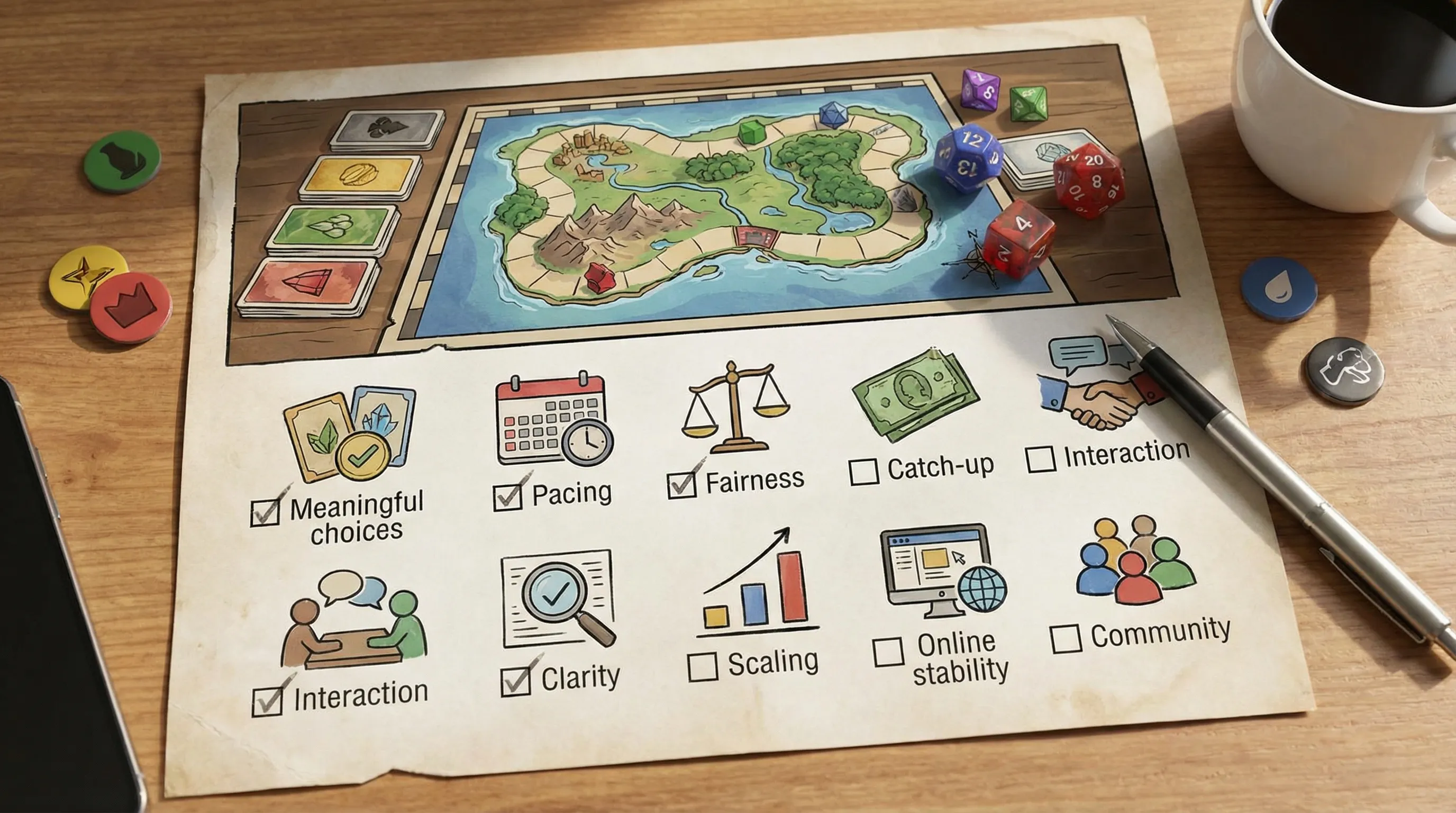
1) Meaningful choices: decisions should matter early and often
A great multiplayer strategy game gives you real decisions at a high frequency. That does not mean every turn is complex. It means your choices shape your odds, your positioning, and your relationships.
What to look for:
- Multiple viable paths (not one “correct” build every game).
- Tradeoffs that are hard in a good way (short-term gain vs long-term setup).
- Decisions that interact with the board and the players, not just your own engine.
Red flag: your first few turns feel scripted, and the winner is mainly decided by who drew better or started in the best seat.
2) Interaction density: the game should create conversation, tension, and negotiation
In multiplayer, “interaction” is not only direct attacks. It is anything that makes players track each other and adapt.
In modern online board games, strong interaction often comes from:
- Blocking and racing for scarce spaces.
- Negotiation (trading, alliances, temporary deals).
- Timing windows (who acts before whom matters).
If you love Catan-style play, you already know how powerful negotiation can be: trading turns resources into social leverage, and “who needs what” becomes a constantly shifting puzzle.
Red flag: everyone mostly plays their own board, and the only interaction is comparing scores at the end.
3) Fairness and perceived fairness: players must accept the outcome
Competitive multiplayer lives or dies on acceptance. People will tolerate randomness, even a lot of it, if the game helps them feel outcomes were understandable and influenced by decisions.
Fairness has two layers:
- Actual fairness: is any strategy or role clearly dominant?
- Perceived fairness: does the game feel like it gave everyone a fair shot?
Good design improves perceived fairness with readable information, clear causes (“I lost because I expanded too late”), and counterplay options.
Red flag: players blame the game more than their choices, especially repeatedly.
4) Catch-up pressure: avoid the “I knew I was dead at minute 15” problem
Snowballing can be exciting for the leader and miserable for everyone else. Great multiplayer games manage this without making early success pointless.
Common tools include:
- Soft catch-up: the leader becomes a bigger target or pays an efficiency tax.
- Dynamic value: what is strong early is not automatically strong late.
- Alternative win lines: different paths let trailing players pivot.
In negotiation-heavy games, “catch-up” can also be social: if you are behind, deals might be cheaper, and opponents might underestimate your comeback.
Red flag: one player gets ahead and the rest spend an hour watching it happen.
5) Pacing and downtime: engagement should not be turn-bound
One of the simplest predictors of multiplayer success is whether people stay mentally present.
Great games reduce downtime by:
- Keeping turns short (or at least predictable).
- Creating off-turn decisions (planning, reacting, trading).
- Making the board state legible so you can re-enter quickly.
If you are playing online, friction matters even more. A browser-based game can have a real advantage here because it reduces the “setup cost” of getting people into a match.
Red flag: players constantly ask, “Wait, what happened?” or start multitasking because nothing involves them.
6) Clarity and readability: the board should explain itself
Strategy players enjoy complexity, but they hate confusion.
Clarity is not about dumbing down. It is about making the current state and the next decision obvious to parse:
- What are the meaningful threats?
- Who is close to winning?
- What are the scarce resources or choke points?
Online, UI is part of game design. A trading game with unclear offers or hidden constraints often creates “UI losses,” where someone misclicks or misses information rather than getting outplayed.
Red flag: new players lose because they did not understand what they were allowed to do, not because they made a strategic mistake.
7) Skill expression: the game should reward learning without requiring homework
A great multiplayer game supports a satisfying learning curve: you get better, and you can feel it.
Skill expression can come from:
- Probabilistic thinking (risk management).
- Negotiation and reading the table.
- Timing and tempo.
- Long-term planning with flexible pivots.
If you want a quick lens for “what kind of players will enjoy this,” Bartle’s classic player types (Achievers, Explorers, Socializers, Killers) is still a helpful conversation starter in communities, even outside MMOs (see Bartle taxonomy overview).
Red flag: improvement feels capped quickly, or mastery mostly means memorizing a single opening.
8) Player count scaling: the game should be good at the size you actually play
Many multiplayer games are “best at 4,” but real groups are messy. Great multiplayer design either scales well or is honest about its sweet spot.
Consider:
- Interaction changes with player count: negotiation games can become chaotic at high counts or too dry at low counts.
- Downtime increases: a game that is crisp at 3 might drag at 6.
- Balance shifts: certain strategies become stronger with more players targeting each other.
When evaluating, ask: Is this designed for my usual group size, or am I forcing it?
Red flag: the game becomes a different (worse) experience outside a narrow player count.
9) Online readiness: stability, reconnection, and low friction are not optional
A multiplayer game can be brilliant and still fail online if it does not respect players’ time.
For online board games especially, “readiness” includes:
- Fast lobby creation and inviting friends.
- Reconnection support (people disconnect, it happens).
- Sensible handling of leavers (AI takeover, pause, or clear rules).
- Moderation and reporting tools, if public matchmaking exists.
It also includes access friction. If a game is playable instantly in-browser, that can be the difference between “We should play sometime” and “We’re in a match right now.”
Red flag: half your sessions end due to technical or social failure, not gameplay.
10) Community and meta health: great games create teachers, rivals, and traditions
Long-running multiplayer games usually have two things:
- A meta that evolves (new strategies, counters, formats).
- A community layer that supports learning and good behavior.
Even if a game is free, community is what makes it feel “alive”: guides, pickup games, balance discussions, and places to find groups. A Discord can be a major asset here because it reduces matchmaking pain and helps new players learn faster.
Red flag: the community is either absent, or dominated by negativity and gatekeeping.
A simple scoring method (so you can compare games quickly)
If you are choosing between multiplayer options, score each criterion from 0 to 2:
- 0: actively hurts the experience
- 1: acceptable, but inconsistent
- 2: consistently strong
Then add one more note: Does the game match what your group finds fun? A highly interactive negotiation game can be a 10 out of 10 for one friend group and exhausting for another.
| Score range (out of 20) | What it usually means | What to do next |
|---|---|---|
| 0 to 10 | Likely frustrating or niche | Only play if your group loves the theme and tolerates rough edges |
| 11 to 15 | Solid, with some pain points | Great for casual sessions, watch the weak categories |
| 16 to 20 | Consistently strong multiplayer | Worth investing time, learning, and building a group around |
What to prioritize for online strategy board games (a practical filter)
If your multiplayer tastes lean toward Catan-like strategy, negotiation, and map control, these criteria tend to matter most:
- Interaction density: trading, blocking, and racing create the “table energy.”
- Catch-up pressure: prevents midgame hopelessness.
- Clarity: you should read the board fast, even online.
- Pacing: negotiation should feel tense, not slow.
This is also where a free, browser-based option can be a legitimate competitive advantage: getting everyone into the same room matters as much as the rules.
A quick way to test a new multiplayer game in 5 minutes
Before you commit to a full session, you can learn a lot by doing a fast evaluation:
- Watch 60 seconds of real gameplay and see if you can explain what matters on the board.
- Ask, “What do I do when I’m behind?” If the answer is “hope,” that is a warning sign.
- Check how quickly you can start a match with friends (invites, private rooms, no-install).
- Look for community gravity (active Discords, regular games, beginners welcomed).
Bringing it home: how this applies to Settlr
Settlr exists in a space where multiplayer design is the product: a Catan-style game lives and dies on interaction, trading, pacing, and the ease of getting friends into a match.
If you are using the checklist above to evaluate a Catan alternative, Settlr’s core premise lines up with the “great multiplayer” fundamentals: strategic settlement building, resource trading, and online accessibility with a community hub.
If you want a practical next step, you can jump straight into a match at Settlr and then use the checklist to rate the experience with your group. For more context on playing with friends online, this guide may help: Free Online Catan with Friends: How to Play Multiplayer in 2026.
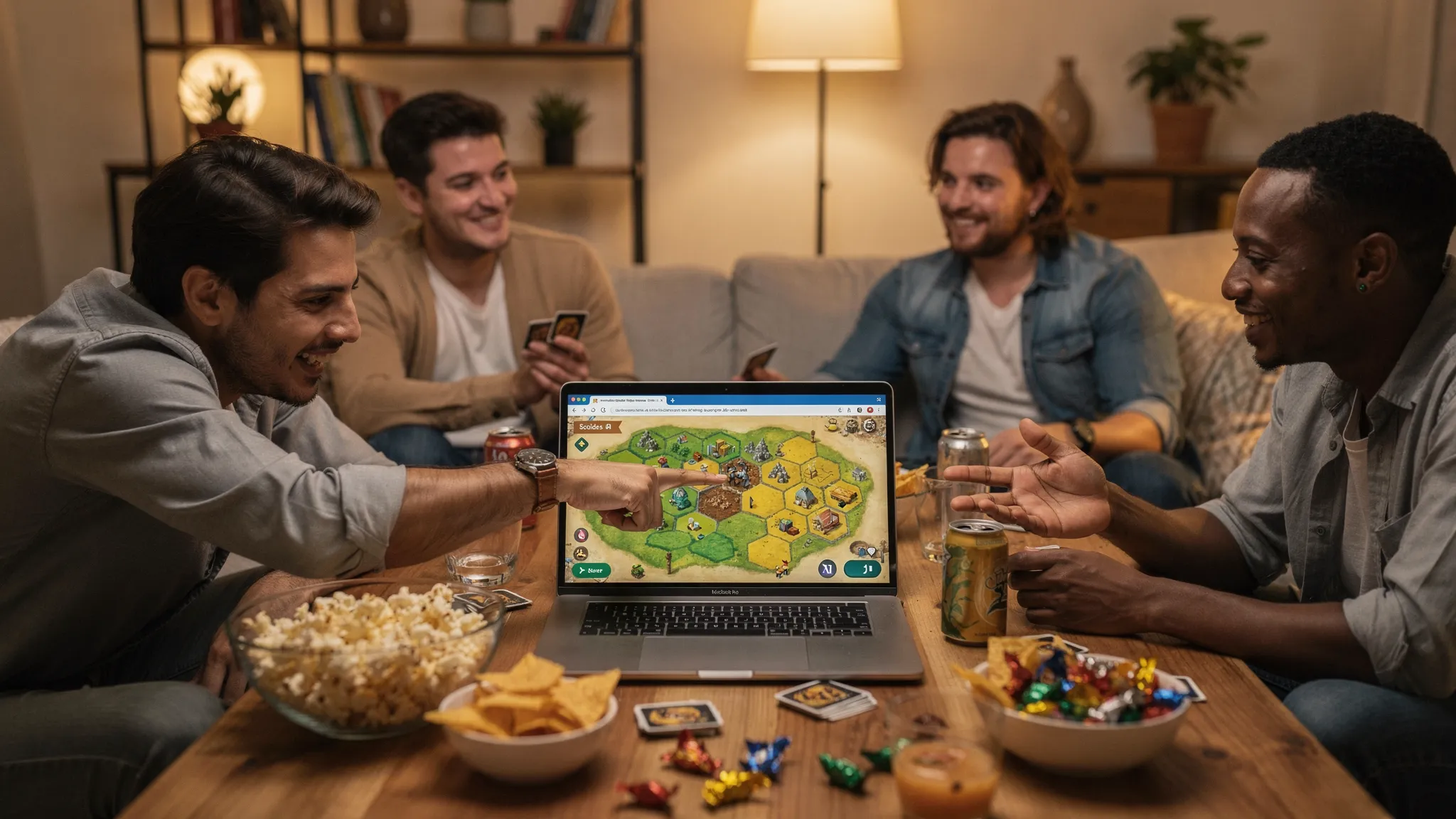
The best multiplayer games are not just well-designed systems. They are reliable engines for good decisions and good social moments. When you find one, protect it, because great multiplayer is hard to build and easy to take for granted.
Settlr Team
The team behind Settlr — a free, browser-based way to play Catan and the Cities & Knights expansion. We write about strategy, game design, and playing online with friends.
Related articles

Play Catan Cities and Knights Online Free - The Ultimate Guide
Play Catan Cities and Knights online free with our browser-based multiplayer platform. No downloads required - enjoy knights, barbarians, commodities, and all expansion features instantly.

Settlr: The Best Catan Alternative with Knights & Cities Expansion and 5-6 Player Support
Play Settlr, the best free Catan alternative with Knights & Cities expansion and 5-6 player support. No downloads, no ads—just pure strategy fun online!